
The enterprise environments are undergoing a silent security crisis at the moment. It does not feature on the news like ransomware but it is spreading more rapidly than a lots of teams know. Instances of AI agents, those which automatically invoke APIs, query databases, send emails, and instantiate workflows, are rapidly increasing in number within companies, and most security programs are not designed to support them.
It is not about the fact that these agents are evil. Most aren’t. The thing is that they do not monitor them adequately.
In 2026, identity security scholars and practitioners are also more considering this a triple risk agentic risk, a lack of governance, and invisibility gap. Each one is serious on its own.
The combination of these factors establishes a climate in which an AI agent is capable of faithfully performing its duties and silently slipping out of bounds to infiltrate other systems smugly and remain there without detection by a human operator over several weeks – since the tools and procedures employed in the human world were not designed specifically to support machines operating their missions at machine speed.
Table of Contents
What the Triple Threat Actually Means
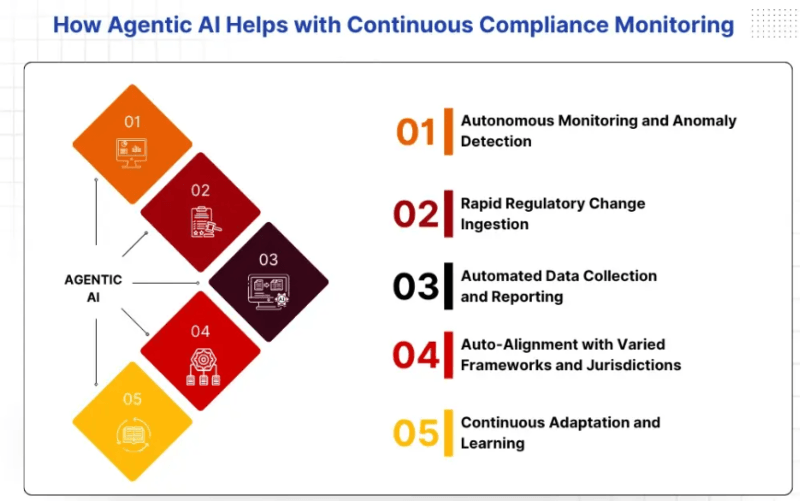
Agentic Risk: High Privilege, Low Accountability
AI agents don’t just read data. They act on it. A wide API access, service account credentials and permissions are commonly provided to them that allow them to get their hands on sensitive systems, not because someone designed it to be so but as an expedience during deployment.
That is agentic risk in action: autonomous systems that are running with high privileges and no comparable level of scrutiny as human user might have. A high blast radius may occur when an agent is corrupted, when it is misconfigured, or when the agent is just acting beyond its scope of operation.
New agentic security risks of OWASP put that in perspective. ASI03 (Identity and Privilege Abuse) deals with situations wherein agents take advantage of roles that are too liberal or roles that masquerade as another identity. ASI10 (Rogue Agents) deals with the cases when agents act far beyond authorized boundaries all together – e.g. they are compromised or drifted by the instructions. These two are commonly becoming real threat patterns in 2026 deployments.
Governance Deficit: Manual Processes, Machine-Speed Problems
The majority of identity governance programs had been tailored to human employees. Reviews of access take place after every quarter. Managers receive certifications which they rubber- stamp. Normal queuing of offboarding adheres to a ticket line.
The model fully fails in AI agents. An agent could be launched, have permission, fulfill its purpose, and sit idle with open credentials – all in a period that not even a quarterly check by anybody would reveal. My exposure to agentic deployment architectures indicated that often organizations had agents which continued to have permissions to projects that terminated long ago months ago.
The gap in governance is not the technology gap it is the process gap. The cadence, ownership, accountability designs upon which identity teams are based were not designed to support non-human identities (NHIs) which can be programmatically created, at scale and in minutes.
Visibility Gap: You Can’t Govern What You Can’t See
Here’s where it gets worse. Organizations must have an idea of what they are governing before governance can be able to reach up. And to the majority, that is really unclear.
The existence of shadow agents is a reality. Agents are spinned up in desktop apps (notebooks), RPA solutions, vendor-hosted SaaS extensions, and inside dedicated developer workstations – usually shared credentials or personal API keys. There’s no central registry. No inventory. There is no mapping between the agent, the human on which it was created and the data it touches.
I came across this trend again and again in the research: identity-observability platforms such as AuthMind are discovering approved and shadow AI agents when initially scanning enterprise settings. The distance between “agents which we know of” and “agents that exist” is usually shocking. In the absence of said inventory, behavioral baselines, anomaly detection and governance processes are effectively blind.
Behavioral Monitoring and Anomaly Detection: What “Normal” Looks Like for an Agent
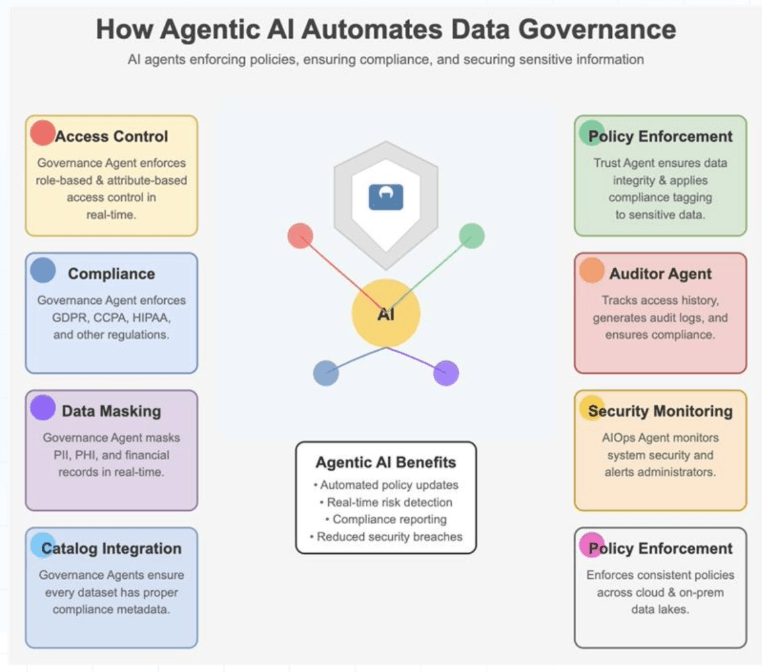
This is what monitoring and anomaly detection and agentic identity governing is technically all about, and it is what is actively developing in the field.
Building Behavioral Baselines
To a human user, behavioral baselines monitor such information as the location of login, access hours, and file usage. The signals are different in case of an AI agent:
- Does this agent make any API calls? And at what frequency?
- To which data stores does it connect to? What are the schemas, tables or S3 buckets?
- With what systems does it have communication? What’s the normal call graph?
- When does it operate? Does it act in a manner that corresponds with its mission statement?
Security products are currently extending UEBA-like baselining to agents – monitoring every-agent API calls and data access patterns and resources used, as well as network interactions between systems. It is aimed at establishing a behavioral envelope that indicates normal operation, then indicating anything that is outside this envelope.
This is an intellectually simple but technically challenging concept. The change in behavior of agents can be legitimate with change in tasks. The system must be able to differentiate between the real drift, and legitimate change, which the system must be closely integrated between the monitoring layer and the orchestration layer on which the agents are hosted.
Detecting Drift and Anomalies
Detecting Drift and Anomalies
- Between two data environments an agent is touching a new data environment.
- Sharp increases in API call volume when there are no normal operating windows.
- Demands of information on data not specified by the agent in purpose or scope.
- Lateral movement patterns – the system of the agent making calls which are unnecessary to its specified task.
- Reuse of credentials and use in various agents/ environments.
These detections often rely on unsupervised clustering, autoencoders or statistical threshold models under the hood, applied to the events that agents generate, but the same tools that are used in the classical UEBA. This output going into SIEM/SOAR pipes has autoscale options: blocks API calls and/or revokes tokens and/or disables the agent and/or forwards to an investigator.
The difficulty, just like anyone with experience of dealing with high-volume agent telemetry, is false positive rate. The agents are responsive and dynamic. Traditional rule-based surveillance generates alert floods. The behavioral analytics must be able to keep up with quick concept change – such as adversarial effort to gradually change the definition of normal as time progresses.
Governance Processes That Actually Work for NHIs
An agentic identity governance is governed by the same logic as human identity governance – the details appear different in each step.
Regular Reviews and Certifications for Non-Human Identities
The access certification model, in which a manager will look and confirm a worker access, should have a similar one in terms of agents. Practically, that means:
- Each agent has a human owner that is named, responsible to its purpose, risk profile, and lifecycle.
- NHIs access reviews occur with a specific cadence (monthly or every sprint (high- risk) of lower-risk).
- Reviews do not merely cover whether or not this agent still requires access, but are it in the best interests of the good of the principal?
NHI is being integrated into SailPoint and other identity governance platforms to allow organizations to bring agents into their identity governance workflows, which allow service accounts and privileged users to be certified. This is in its infancy but the general thrust is obvious: agents are identities and identities are reviewed.
To get a further discussion on why this is important structurally, the article Identity Crisis – Securing Non-Human Identities to AI Agents describes the ownership and accountability model step-by-step – it is worth reading with whatever governance framework implementation.
Machine Identity Hygiene as a Compliance Expectation
New frameworks – such as interpretations of NIST AI RMF and industry-specific advice – are beginning to realise machine identity hygiene as a stated control expectation. That means:
- Each agent will be identified by a unique identifier, and not a shared credential.
- Loosely identity, time-fenced, least-privileged credentials, which exire and must be renewed.
- The logs are immutable and, therefore, require no processing, and binding each action to a given agent identity with a set of timestamps and scope claims.
- Listing of purpose of each agent, data domains accessible to it and risk rating.
One of the more explicit known public examples of such is the work produced by Microsoft that is called Architecting Trust which uses NIST AI RMF on AI agents.
It includes special Entra Agent IDs, declaration of business ownership by agent, and gating by manual human intervention of risk actions. The structure of the NIST AI RMF Govern/Map/Measure/Manage is naturally intuited to the governance of agents when you consider each agent to be a system that is the subject of a continuous risk evaluation.
Incident Response When an Agent Goes Rogue
Despite the sound surveillance and control, accidents will occur. Agents get compromised. Credentials get leaked. Unintentional access is caused by faulty permissions. Once that occurs the speed of response counts it all – since the agents work as fast as machines and so does the damage.
The Rapid Response Playbook
A functional incident response process of NHI/agent abuse is comprised of:
Immediate containment
- Consider denying the API tokens and OAuth grants of the agent.
- Turnover any service accounted credentials the agent utilized.
- Inactivate the agent at the orchestration level, not merely put it out of commission, but completely isolate it.
Scope assessment
- Fetch all the full activity logs of the agent all API calls, all accessed data objects, all systems since the onset of the anomaly (since the last known clean baseline).
- Determine the blast radius: what systems were accessible to the credentials of this agent? What data was accessible?
- Determine any movement to the sides, i.e. whether the agent actions opened up other access points?
Root cause and remediation
- Was this a tradeoff (external attacker impersonated the agent) or an incorrect setup (the agent executing actions that it was not supposed to perform under its authority)?
- Review phraseology, revoke superfluous permissions and revise the behavioral baseline prior to reinstillation.
- Record all that can be audited like time, actions carried out and amendment of policies.
Post-incident governance update
- In case of an unclear set of credentials of the agent that was not supposed to exist (stale keys, over-scoped roles), initiate a wider audit of such agents.
- Revise access certification schedule, in case the incident showed a disjunction in review call frequency.
I have employed logical reconstructions methods by logging in incident investigations and the quality of agent telemetry connects or ruins the investigation.
Companies registering mistakes alone are driving in the dark. The ability to attain attribution and scope evaluation in the event of a failure is achieved by full trace-level logging frameworks of each API call, each authentication action, and each access of each data point.
My Take on Where This Is Actually Headed
The discipline is accelerating at a rapid pace, and some of the directions are starting to take shape.
Graph-based identity maps are becoming the visual representation of agentic environments – who talks to what views, which connect agents, tools, datasets, and human owners so identity theft can be analyzed what impact was being made on the data before an incident, and not after.
Registration-time-only checks are being substituted by continuous checks. IAM models are defined by platforms such as Dock.io as verifying agents with each action, rather than only during their onboarding – with just-in-time access decisions of on-demand intent on an API request.
The vendors such as SailPoint, are adding risk-adaptive controls: behavioral monitoring-based, live risk signals used to issue and revoke credentials. When an agent begins to act anomalously, it tightens its security credentials automatically no human interaction needed to respond first.
And NIST AI RMF conformance is no longer a point of difference, it is a standard requirement. Companies that fail to map their agent governance to Govern/Map/Measure/Manage will be culturally out-of-step with the regulatory preparedness as well as security maturity.
The first problem to solve is the gap in visibility. All the other things, including baselines, anomaly detection, governance reviews, incident response, are all reliant upon knowing what agents you have, owner and what they are doing.

I’m a technology writer with a passion for AI and digital marketing. I create engaging and useful content that bridges the gap between complex technology concepts and digital technologies. My writing makes the process easy and curious. and encourage participation I continue to research innovation and technology. Let’s connect and talk technology!