
Last updated on December 20th, 2025 at 11:51 am
I will tell you honestly, I expected this to be the case, both tools overrated. That is what AI video generators never fail to promise, right? However, upon spending a week using Runway ML and InVideo AI one after another, I also got to know some things that literally astonished me.
This is what really happened.
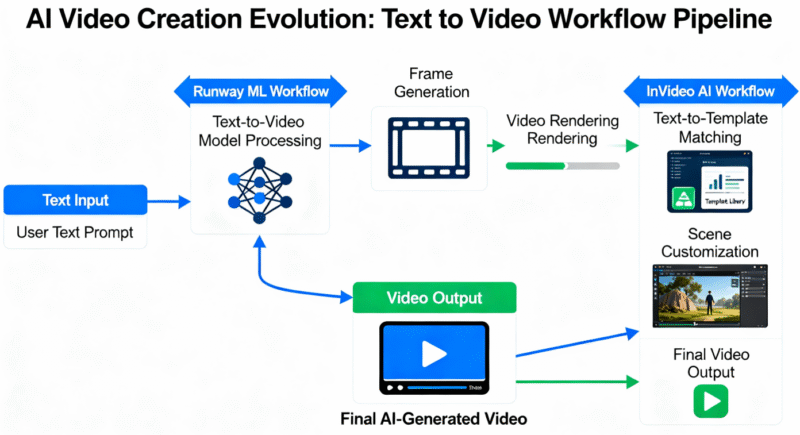
Table of Contents
What I Tested First: Runway ML
I began with Runway ML since everybody referred to it as the professional one. They were not joking when we talked of the learning curve.
Getting Started:
I enrolled in the free version (125 credits to play around with). The dashboard was uncontaminated and threatening. There’s Gen-4, Aleph, Act-Two… I had no idea where to start.
My First Video Attempt:
I entered just a few items like “cat treading briskly through a rainy night at street. Hit generate. Waited about 2 minutes.
The result? Actually impressive. The movement was fluid, the lighting seemed film-like. However, there is the twist to this matter – that 5-second video consumed 12 credits. I used up my free credits in possibly 20 minutes of testing.
What I Learned about Runway ML:
- Their latest one is Gen-4, then it is slower, but better quality compared to the Gen-3.
- Credits go very quick – even those that fail you.
- The editing features are insane – Aleph lets you edit videos by typing command to it (such as make the sky purple).
- It is designed to control freaks – it can be configured to any extent, though there is much to know.
The most impressive workflow: First write something in ChatGPT and then use it as your prompt in Runway. Always use Fixed Seed toggle otherwise your results will be similar. Do not fritter credits away trying accidents.
Then I Tried InVideo AI
The transition to InVideo AI was similar to the one between Photoshop and Canva. Not bad at all– it was only different.
Getting Started:
The interface literally follows with: What video do you want to make?” I entered A 60-second educational video about the process of brewing coffee and pressed enter.
What Happened:
It produced a complete video after 3 minutes. Voiceover, soundtrack, stock shots, text fades – it’s all. I touched not a single setting.
Was it perfect? No. The algorithm selected some bizarre stock footage ( why is there a person jumping out of a coffee video? ). However, it could be put to immediate use.
What I got to know about InVideo AI:
- It is template-based It does not create videos unscaffolded like Runway.
- It is the game of speed – you can make videos in minutes.
- Voice cloning is real – I cloned 30 seconds of myself, and it used them in videos (it is a bit creepy, a bit cool)
- The AI is the luck of the draw: some times it hits the nail on the head and others you find yourself spending 20 minutes at the keyboard.
Best overall workflow that I discovered Be very specific in your prompt. Do not tell me to make a video about coffee. When asked to make a 60-second You Tube video on the brewing of French press coffee of the casual tone and targeted at beginners. The more detail, the better.
The Honest Comparison
Having tried the two, my real opinion is as follows:
When a final product is of interest (and it really should look like a product, not a movie) then you choose Runway ML. You will consume more time, consume more credits and there is likelihood that you will watch some tutorials. But the output? Chef’s kiss.
InVideo AI will be your solution when you want a content quickly. Instagram posts, brief explainers, promotional videos, things where time is the most important, not the best. It will not take home film festivals, but it will get the task done prior to lunch.
Which One Did I Keep Using?
Plot twist: I use both.
I will create base footage in Runway ML when I have to have something particular not a part of stock libraries. This I then import into the InVideo AI to do fast-edits and text overlays.
InVideo AI is the first one to use, in case you only have to get acquainted with it. It is not as punishing, much faster and you will at least complete videos rather than be held back in tutorial hell.
However, as long as you have serious intentions to quality and you are ready to learn, Runway ML is worth the headache. Simply allocate a budget to the paid plan, the free credits will not make it.
FAQs
Which platform is better for beginners?
InVideo AI, hands down. I created a video that was useful within less than 10 minutes with no prior knowledge. I spent 2 hours of tutorial viewing time and was quite comfortable with runway ML. The template system and drag and drop interface of InVideo is just logical. You put the words you desire in, it assembles it, you refine it. Done.
However, when you are an amateur and are interested in learning to create videos, and not merely churn out their stuff, Runway ML will teach you much more about how video generation works.
Can I use generated content commercially?
Yes, for both platforms. Runway ML provides a full copyright ownership as well as free use of commercial rights of whatever you produce. The same applies to all paid plans of InVideo AI.
I even initially checked that it is not a joke, it was too good to be one, but yes, you may utilize the videos in client work, advertisement, monetization of YouTube, whatever. All you need is to make sure that you are subscribed to a paid plan with InVideo AI (the free one has a watermark and limitations).
Also Read: AI Tools for Content Creation & Design

I’m a technology writer with a passion for AI and digital marketing. I create engaging and useful content that bridges the gap between complex technology concepts and digital technologies. My writing makes the process easy and curious. and encourage participation I continue to research innovation and technology. Let’s connect and talk technology!