A redacted bank statement is a copy of your original statement with all personal information (account number, routing number, personal transaction descriptions, etc.) blacked out. Still, everything a verifier needs to see (your name, the bank’s name, the date range, deposits, and closing balance) remains visible. They are used for rental applications, loan underwritings, proof of funds, and all cases where you want to prove your finances but not show them all in the process.
Table of Contents
What Is a Redacted Bank Statement?
Imagine your bank statement contains two types of information: one type proves your financial position; one type puts you at risk if it comes into the wrong hands. Redaction is the process of separating those two types and permanently deleting the second type from the document.
A normal statement includes your full account number, routing number, each deposit or withdrawal with the payee or source, and, in some cases, a daily balance that updates throughout the day. The redacted version will remove the unnecessary identifiers that aren’t request-relevant – such as crossing out the account number to the last 4 digits – and will still include your name, the bank logo, the statement period, and your deposit history.
The keyword here is permanently. A statement is not properly redacted if it appears that way on screen. If the text is still present in the file-if it is highlighted, copyable, or retrievable through metadata-then it isn’t redacted; it’s just obscured. That difference matters far more than many believe, and it is one of the most common errors people make when preparing documents.
What Does “Redacted” Mean on a Bank Statement?
“Redacted” gets used loosely, so it’s worth separating it from similar-sounding terms:
- Redactions eliminate the base data within the file. When done properly, the data cannot be retrieved by anyone who receives the document.
- Deletion means removing the whole line, transaction, or page rather than hiding one field.
- The Impact of Editing… editing alters the document itself (unlike redacting) and might create authenticity issues if a court or lender compares it to the original.
- Hiding or masking (such as inserting a black box in an image editor or password-protecting a PDF) only changes what appears. The data is often still present beneath.
If you hear someone say a document is permanently redacted, they mean the document’s structure has been altered to look concealed. The look level of redaction that most banks, landlords, and legal reviews require if you’re to hand in a copy that has been redacted in any form.
Why Would Someone Need a Redacted Bank Statement?
Providing a complete bank statement gives you more information than your information provider actually needs. You can redact it to provide what is required without sharing the entire statement. You may choose to use redaction for:
- Protection of identity. Account and routing numbers are information someone would need to try to perpetrate a false transfer.
- Rental applications. A landlord would generally ask for evidence that you can pay your rent, rather than what you spent on shoes last month.
- Loan and mortgage applications. For underwriters, deposit history and balance trends are important, not every detail.
- Proof of funds/ income. Buyers, sellers, and employers may inquire for proof of funds. This is used without providing a second level of detail of the transaction.
- Identity- proof of address. Certain institutions will accept a bank statement as proof of address, and the financial information is then of very little consequence to them.
- Business/accounting validation. Accountants, business associates, or bookkeepers might need validation of a balance or the classification of a transaction without exposing an individual’s unrelated spending.
- Requests for legal documents. Divorce proceedings, litigation, or discovery requests sometimes require financial documents specific to the matter at hand.
Important caveat: the recipient decides what they need to see, not you. Withholding information the recipient wants to see can hinder the process as much as sharing information that might pose a risk.
What Information Should You Redact From a Bank Statement?
Account #. Please hide all the digits besides the last four. In most cases, you don’t need the full number for validation, and it’s often the most sensitive field on the page.
Details of each transaction. Names related to individual purchases, health centers, magazines, or personal spending profiles generally aren’t important for the person requesting the statement.
Address. Your address may not be needed if the request requires verifying your identity through your name and account.
Phone number; contact info. Occasionally, your statement may include a customer service number or a contact field associated with your account, which you can generally remove without harming the usefulness of the statement.
Personal identifiers. DO NOT include Social Security numbers, tax ID numbers, and any PIN or access code in any copy of the record (redacted or not).
Unneeded reference numbers. Internal bank reference numbers or customer numbers that do not add value for the person receiving the document are acceptable to remove.
What remains in view will also depend crucially on the purpose for which it is intended. That’s why the second section is so important.
What Should You NOT Redact From a Bank Statement?
Over-redactions, a common mistake, are as damaging as under-redactions: they can cause rejected applications, delayed loans, and requests to resubmit an unredacted copy.
Generally, keep these visible unless the recipient tells you otherwise:
- ACCOUNTHOLDER’S NAME: name of the account holder (the person to whom the account belongs); required for most verification purposes.
- Bank name and logo verify the statement is authentic and from a genuine bank.
- Date and period of the statement identify the timing of financial activities.
- Is the requested balance (deposit totals, closing balance) the main purpose of the document?
- Transaction information: if a lender requests a particular transaction, blanking it out defeats the purpose of providing the statement.
There’s not a hard-and-fast rule of how far you cross the line. It depends on why you want the document in the first place. A rental application and a mortgage underwriter aren’t going to require the same amount of information, so it’s good practice to check with the recipient before you begin blacking out.
What Does a Redacted Bank Statement Look Like?
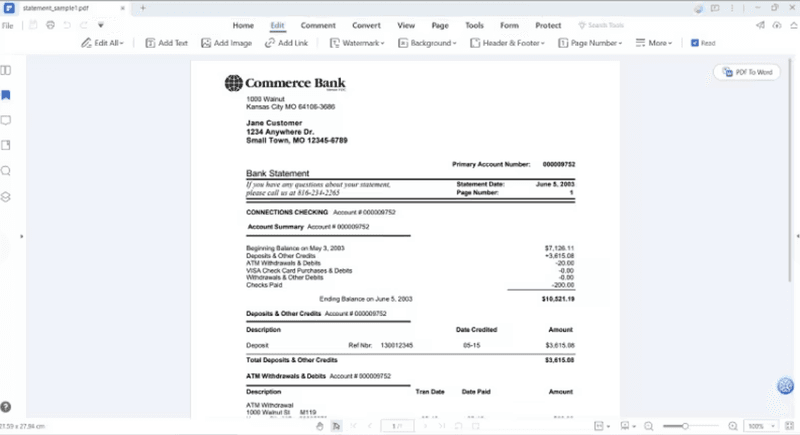
Imagine a typical statement page: bank logo at the top, your name and address underneath, followed by a summary of the account activity, and then all the transactions listed one after another; a correctly redacted statement would maintain that organization, but black out the sensitive details; the account number itself is shown only in the last four digits, transaction descriptions are obscured with solid black bars, and personal identifiers are blacked out completely (name, address, account number, whatever). The statement period, deposit totals, and end-of-period balance stay as-is so you can quickly identify and cross-check the document; the identifying details are no longer usable.
How to Redact a Bank Statement
The general process looks the same no matter which tool you use:
- Just download a digital version of your statement. A PDF is better than an image scan.
- Determine precisely what should be suppressed (according to the identity of the requester and the reason).
- Use the right redaction tool; switching to paint or a highlighter over text on paper will not do.
- Use these redactions on the fields you’ve picked out.
- Open the redacted document with Microsoft Word. (It may be saved as a WordPad document, in which case you will have to open it with Word.) You can find it under the icon of a blue “W”.
- Fail-safe. Make sure the information really is deleted before you send it.
- In the event of a redaction, leave the unredacted original copy in a safe place for your records.
Acrobat has a redaction tool (under Tools > Redact) that, instead of just highlighting the section to be redacted, covers up the text below so it cannot be read. This is one of the limited free-to-use options that does the job properly if you have access to the complete version of Acrobat.
Microsoft Word has not been built with redacting capabilities in mind. Text blacked out in Word and then exported as a PDF may still be recoverable. It should not be solely relied upon.
Specialized PDF editors designed for redacting (as opposed to viewing other people’s PDFs) usually have a “true redaction” mode that erases the text layer rather than painting over it.
Banking apps and online portals vary widely. Some banks let you download statements partially redacted by default, but that isn’t true for all banks, so check with yours.
How to Permanently Redact a Bank Statement
This is the most important step in guides like this, and one you will most likely forget. In most PDF viewers, a black box over text doesn’t actually delete anything; it just overlays the content layer. If someone extracts the text underneath, or opens the file in a different viewer, or examines the data stored in the document itself, what you’ve redacted can be reconstructed:
To redact permanently:
- Employ an application that supports the positive redaction of PDFs-which is, removing the text/image data beneath, not merely the visible top layer.
- Flattening or exporting the document when finished redacting will “flatten” the file. This “flattens” the file so that it cannot be changed.
- Test the output by attempting to select and cut-paste text underneath the redacted areas with a different PDF viewer than the one you used to produce it.
- Verify the document metadata. Any author fields, revision history, or embedded thumbnails might still be hiding the information you thought you’d cleaned.
- Clipped the file, then generate a separate redacted copy and do not simply occlude the existing one.
- Never, never, save or change in any way your original declaration. Leave it as it is, so you will have it intact should you later need to produce it in its entirety.
This step seems trivial but is actually more important. Financial records are a common attack point in online attacks and identity theft schemes, and a poorly redacted statement may reveal exactly the information it is meant to hide.
Read: Mobile Apps Testing on Cyber Threats without the Bank Breaking Test.
Can You Submit a Redacted Bank Statement?
It may depend entirely on who is asking. Some organizations will accept redacted statements as long as the redacted fields are a different color and easy to see. At the same time, some will require the full, unredacted copy, especially if the documents are being sent for legal, immigration, or formal underwriting purposes. The best thing to do is to contact the asking organization and be sure that they will accept a redacted copy before doing away with anything; if they won’t accept a redacted statement, then any work done on removing info will be for naught.
Can a Redacted Bank Statement Be Used as Proof of Funds?
Most of the time, yes, but only if the redaction isn’t obscuring something the recipient needs to know. Proof of funds requests verify that you actually have the assets you claim; from a lender, seller, or escrow company’s perspective, the balance and deposit history are generally necessary. Redacting individual transaction descriptions isn’t an issue; redacting the balance defeats the whole purpose of sending proof of funds and will most likely be rejected.
Can a Redacted Bank Statement Be Used as Proof of Address?
Now and then. Sometimes, if a statement is being used solely to verify the fact that you do reside at that address, the specifics of your finances may not actually be relevant to the agent (though the address, name, and date of statement will need to remain visible). Organization to organization can vary a lot; some may be comfortable accepting a redacted statement, while others will insist on seeing the full thing regardless.
Can You Redact a Bank Statement for a Rental Application?
Yes, and this is one of the reasons that is frequently cited for a first redaction. Rental agents/landlords want to see that you have the money to pay rent-not look at every penny you have spent (while this may be nice to know, the reality is we want to see your ability to pay rent). Including deposits and balances on a redacted bank statement often achieves this. However, some agencies may require a full statement as part of their policy, so it’s worth checking first.
Can You Redact a Bank Statement for a Loan or Mortgage?
This is where the redaction process becomes riskier. When a lender asks for statements, they specifically want to see deposit activity, income information, and the source of large deposits. If you redact earnings-related transaction descriptions too heavily, it can lead to further requests for documentation or even total denial. Follow the documentation required by the lender, not intuition about what should be hidden.
Is It Safe to Share a Redacted Bank Statement?
Redaction reduces risk, but you still can’t become careless when sending the document. Some tips worth heeding:
- Always double-check who you’re sending it to before sending anything sensitive.
- Whenever possible, transmit the file using a secure transfer method instead of an unprotected email attachment.
- Add password protection to the file if the destination or platform allows.
- Never upload any financial reports to a publicly accessible site.
- Final verification: Open the PDF again in a new viewer and try to select the text beneath the redaction.
Can Someone Unredact a Bank Statement?
If the redaction was made correctly, i.e., the underlying text was deleted, not merely obscured, then no, there is nothing left to recover. If it was made using a visually overlayed box, rather than actual redaction, then yes, the redacted data remains extractable in some cases through copy and paste, layer inspection, or meta-data this is precisely why distinguishing “true” redaction from merely visual redaction is so crucial, and why testing your output before sending it is such a worthwhile step every time.
What Are the Risks of Sharing an Unredacted Bank Statement?
An unredacted statement has enough information to enable someone to try to do account takeover, apply for credit in your name, or gather enough personal information to use in a social engineering attempt. The risks include identity theft, unknown transactions, your spending habits and relationships exposed through transaction descriptions, or simply sharing more of your life than you should. None of those imply that you should redact every statement you ever submit — but anything you give out (especially outside a secure, direct banking relationship) is worth considering what truly needs to be disclosed.
Redacted vs. Unredacted Bank Statement
| Sensitive information | Hidden | Fully visible |
| Privacy | Higher | Lower |
| Verification | May be limited | Complete |
| Best for | Limited-purpose sharing | Full financial verification |
| Acceptance | Depends on the recipient | Generally accepted everywhere |
Redacted vs. Censored vs. Anonymized Bank Statement
These are similar but not the same. Redacted generally means specific areas are deleted permanently, and the rest of the document remains while remaining attributable to you. Censored is a more general form of obscuring or blocking content, not necessarily permanent. Anonymized is even broader, and means that the document has been processed in a way that any identification to a specific owner or account has been removed, something most redacting bank statements doesn’t do, as you still need to see that it’s your document.
Common Bank Statement Redaction Mistakes
Using a black box rather than redaction in the rules. It’s the most common error and the one most likely to leave residual recoverable data.
Redacting information the receiver would need. Obscuring balances, dates, or necessary transactions can cause your project to be refused outright.
Editing the copy statement. Modifying the source document through a checkbox and “post editing,” rather than producing a redacted statement, invites credibility issues if it is cross-checked with bank records.
Can’t find hidden PDF data. Metadata, cached thumbnails, and edit history may leave things present that the visible page no longer shows.
Wrong version sharing. More frequent than some realize, someone sometimes uploads the actual document and not the redacted versionâ€- more often, in fact, than we wish. This often happens with very similar names.
Delete the final document. Skipping the verification step, where you try to select text under redacted areas, means you’re relying on the software to have worked.
Beingover-zealousandover-redacting information. Filling up your page count to avoid penalties for being irresponsible can be just as damaging if the application is rejected.
Frequently Asked Questions About Redacted Bank Statements
What is a redacted bank statement?
A redacted copy of your bank statement by permanently removing sensitive fields the account numbers, personal details of the transactions, dates, which would be needed for verification purposes remains available.
Why would you redact a bank statement?
To avoid revealing everything about yourself financially and personally when making a statement to support a rental, loan, or reference application.
What information should you redact from a bank statement?
Redaction most often involves removing account numbers, routing numbers, SSNs, PINs, and excessive transaction detail.
Can you redact a bank statement?
Yes, that is possible as well. You can do this using tools designed for redaction, rather than a simple visual cover-up like a black box in a photo editor.
Is a redacted bank statement valid?
It’s good enough for many things, but acceptance varies by organization. Some will need a full unredacted statement.
Can a redacted bank statement be used as proof of funds?
Yes, most of the time, as long as the balance and deposit history remain visible and legible.
Can someone recover information from a redacted PDF?
With a good introduction. Correct redaction erases the secret data and leaves us with blank pages!
Can a bank provide a redacted bank statement?
Some banks also offer a masked statement on their website (depending on the bank), so it’s worth asking your bank.
Final Thoughts
An appropriate redacted bank statement demonstrates your financial strength without disclosing your entire account. The biggest mistake most people make isn’t choosing what information should remain visible, but believing a black box qualifies as redaction. When creating a redaction, first confirm what the recipient needs, use a process that truly redacts, and double-check the document before distribution.

I’m a technology writer passionate about AI and digital marketing. I create engaging and useful content that bridges the gap between complex technology concepts and digital technologies. My writing makes the process easy and engaging. I encourage participation I continue to research innovation and technology. Let’s connect and talk technology!