Last updated on September 26th, 2026 at 01:30 pm
Ok, I’ll admit it: when I read or heard people throwing terms like machine learning and deep learning around like they mean the same thing, I was confused too—wasted hours reading technical documents that were head-spinning stuff.
Now I would like to break down the difference between deep learning and machine learning in a way that is actually comprehensible.
Table of Contents
The Basic Breakdown
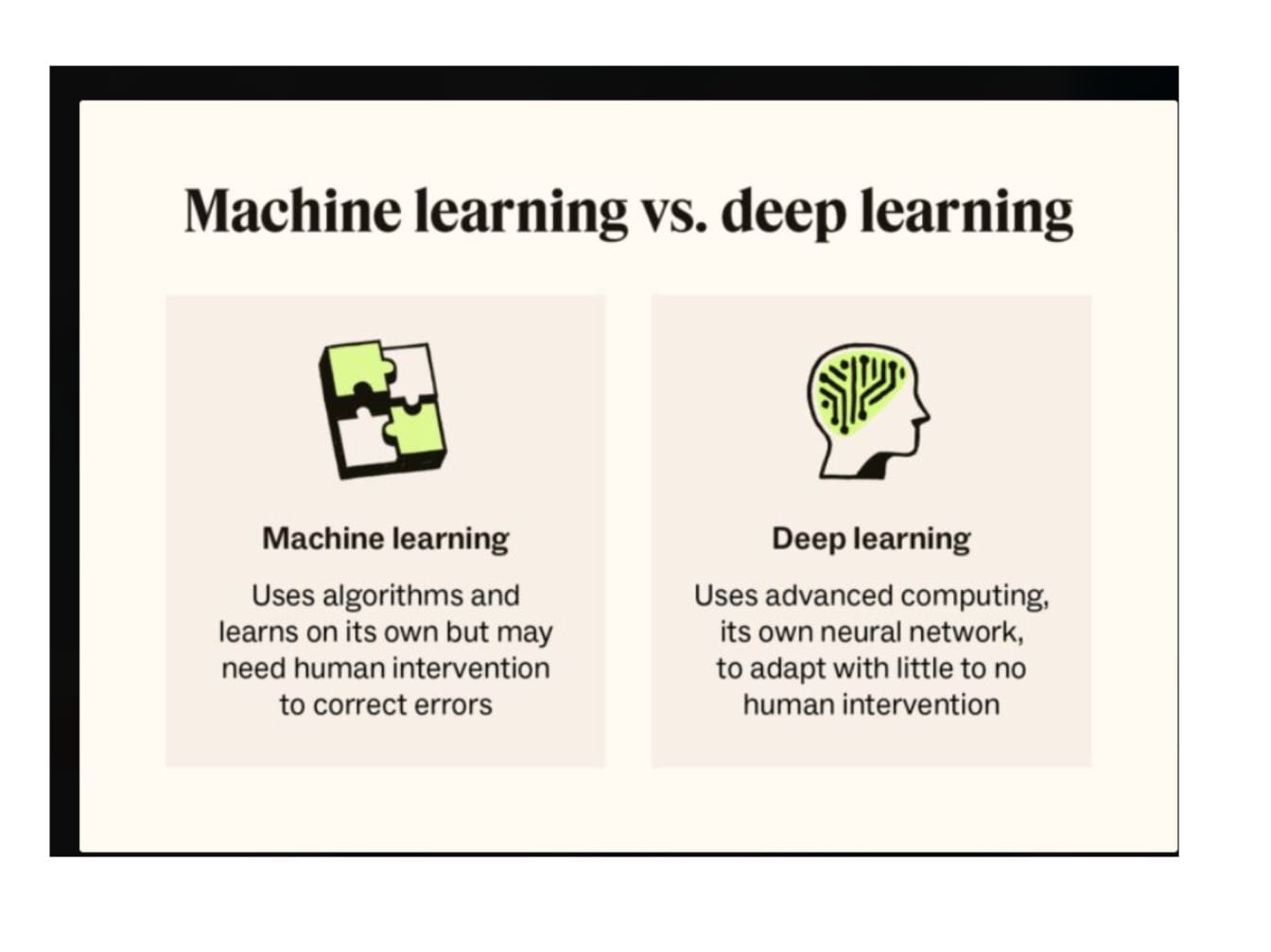
The point is that in this case, machine learning is the parent, and deep learning is the kid. Both fall under artificial intelligence, but they work differently.
I gave myself a simple task: recognizing an image. In conventional ML, I had to tell the system what to focus on: edges, colors, shapes. It was tedious. With deep learning? The model 2 worked it out. And that is the main distinction.
Machine learning uses patterns to decode data through data-based algorithms to make decisions. You give it information; it trains; it forecasts. Simple.
Deep learning goes the extra mile by using multilayered (i.e., deep) neural networks that mimic how our brains process information. It’s ML on steroids, basically.

What Makes Them Different (The Stuff That Actually Matters).
Data Requirements
Traditional ML works well with small datasets. I have built satisfactory predictive models with a few thousand data points. Deep learning? It’s hungry. It devours large quantities of data to perform calculations, which by this measure means hundreds of thousands, even millions of examples.
Feature Engineering
This is when things become interesting. In ML, I spent hours manually deciding which features mattered—for a spam filter, for example. I needed to choose: word count, special phrases, and sender reputation matter. It’s manual work.
Deep learning models learn without being guided. Give them raw data, and they decide what is important. That means I don’t have to do as much work, but I do need much more computing power.
Computing Power
I can run ML models on my laptop. In fact, I have fitted decision trees and random forests on a five-year-old MacBook. Deep learning models? They need GPUs or TPUs. Once, I tried to train a neural network on my CPU, which can’t process images in real time; the process took three days.
Practical Applications (One of which is doing great)
Machine Learning in Action
When that happened to me, ML had sunk it:
Banks detect fraud via machine learning (ML) systems. They do not require the complexity of deep learning, only good pattern recognition of structured data such as the number of transactions, place, and time.
Predicting customer churn works well with classical ML. To identify who is about to cancel, companies look at purchase history, support tickets, and usage trends. I helped build a subscription-churn model with high accuracy using a simple random forest.
ML is applied to medical diagnosis tools for straightforward cases. One of my doctors has an ML system, which means that diabetes risk is predicted depending on the blood sugar level, BMI, and family history. It’s quick, understandable, and doesn’t take hours of processing power.
Deep Learning Dominance
When complexity comes, deep learning comes into play:
Voice assistants like Siri and Alexa are based on deep learning. Simple voice command system – I tried to build a simple voice command system using traditional ML; terrible results. Replaced with a deep learning model that was trained on thousands of voice samples. Night and day difference.
Self-driving vehicles run deep learning on real-time camera images. They identify pedestrians, read road signs, and anticipate other drivers’ actions; it is too complex not to be addressed by classic ML.
Generative AI such as ChatGPT or Claude (yeah, the artificial intelligence you may be using right this second) is a pure deep learning model. These models comprehend context, create human-like text, and support multilingualism. Conventional ML cannot reach this level of complexity.
Trendy Models You will actually meet.
Machine Learning Models
Decision Trees and Random Forests – I use them constantly. They are flowcharts, but the decisions are made on yes/no questions. Quick to learn, simple, and surprisingly effective.
Support Vector Machines (SVM) -Exceptional in classifying issues. I have constructed a simple image classifier that categorized products. Performed well using half of the labeled images (2,000).
Logistic Regression – Don’t be misled by its name; it is a classification algorithm. It’s great for binary predictions, such as whether a customer will purchase. Simple, fast, interpretable.
Deep Learning Models
Convolutional Neural Networks (CNNs) – The anything-visual. I have applied ready-made CNNs in facial recognition and product image recognition projects. They instinctively learn how to identify edges, then shapes, and then complicated objects.
Transformers -These transformed the whole of language processing—transformers such as GPT and BERT models. To learn the relations between words, they use attention mechanisms, even when words are far apart in a sentence.
Recurrent Neural Networks (RNNs): These are used on sequential data such as time series or text. To forecast stock prices, I used an LSTM (a variant of RNN) to predict stock price changes. It is not flawless, but it is better than traditional forecasting techniques.
So Which One Should You Use?
My opinion on the two is presented below: begin with machine learning.
In case you have a small amount of data, you desire fast-moving solutions, or prefer to have a well-conceived insight into precisely how your model makes decisions – you should use traditional ML. It is quicker to implement, cheaper to operate, and easier to explain to non-technical stakeholders.
Resort to deep learning in case you are working with images, audio, video, or natural language at scale. When you actually have lots of data and a processing environment. Interpretability is unimportant, and accuracy is valued.
I’ve seen too many people jump to deep learning because it sounds cooler, only to struggle with overfitting on a small dataset. Don’t be that person.
The Real Talk
The distinction between deep learning and machine learning is not only an academic question to understand, but it impacts the choice of tools you use, the amount of funds you make, and the success of the project you are working on.
Both have their place. ML works much more conveniently with structured, tabular data. Deep learning opens opportunities for unstructured data that appeared unattainable half a decade ago.
Read:
What Is AI ipu cloud and Why should you be interested?

I’m a technology writer passionate about AI and digital marketing. I create engaging and useful content that bridges the gap between complex technology concepts and digital technologies. My writing makes the process easy and engaging. I encourage participation I continue to research innovation and technology. Let’s connect and talk technology!